The short answer
- Want a first draft of a whole portfolio site, fast? That is the use. A written brief produced a five-page sample: home, work with case studies, about, services and rates, and a contact page with a form that checks your answers.
- Need your own photographs and artwork on it? The sample used none. The brief asked for no photographs, so each project cover is a typographic or geometric composition drawn in code. Your real work, and the right to show it, is yours to bring.
- Need your own domain, or an editor you can log in to? uooki has no custom domain support and no CMS. Treat what it builds as a design and a draft. To change a line, you ask the agent.
- Need the contact form to reach your inbox? The sample form checks every field and shows a confirmation, but it sends nothing and stores nothing, and the page says so. Connecting enquiries to your email is a separate step.
What a portfolio website has to do
A portfolio is read quickly and by someone with a decision to make: should I get in touch with this person? That person wants to see a few pieces of work they can judge, a sense of how you think, an idea of cost and a way to ask. Everything else is secondary, and a site that buries those four things has failed however good the work is.
That tends to translate into a small set of pages: a home page that says who you are in a sentence and shows a few projects; a work page with a short case study for each project, covering the brief, what you did and what came of it; an about page; a page for services and starting prices; and a contact page. A builder is useful if it produces those pages well from a description, and does not pretend to do the parts that belong to you.
What the sample site contains
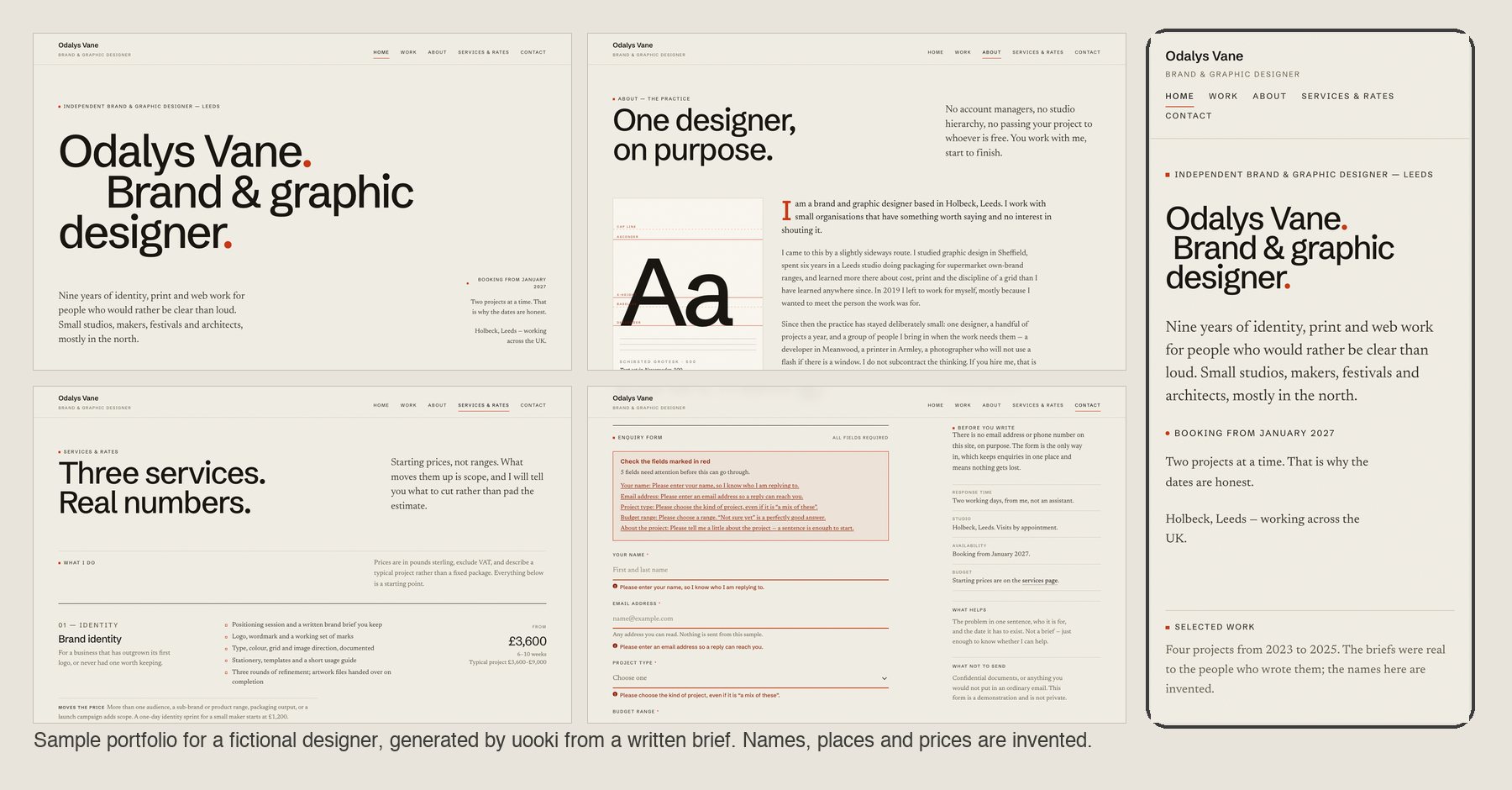
Here are the five pages of an invented independent designer's portfolio, built from a written brief:
Home
A headline and short introduction, when the designer is next taking work, and a grid of four selected projects.
Work
Four case studies, each with the brief, what was done and the result. The projects and clients are invented, and each cover is a typographic or geometric composition drawn in code rather than a photograph.
About
A page about the practice, written in the voice the brief asked for: quiet and confident.
Services and rates
Three services with starting prices, what moves the price and how a project runs. The prices are invented.
Contact
A form with five fields. When you submit it empty it lists every problem at the top and under each field and announces them to screen readers. When it is filled in correctly it is replaced by a confirmation that says nothing has been sent.
A sample portfolio site built from a written brief
Below are the home, about, and services and rates pages, the contact form after an empty submit, and the phone layout of a portfolio built from a written brief for a fictional designer. The designer, the places and the prices are all invented, and the site says so. The images are screenshots of the result.
What you get from the brief, and what is still yours
A site builder is only honest if it says where its job ends:
| Part of the site | From a written brief | Still yours to do |
|---|---|---|
| Design and copy | A consistent look and first-draft wording on every page, in the tone you ask for | Read every line and rewrite what does not sound like you |
| Case studies | A structure for each project (the brief, what you did, the result) and a first draft | Your real projects and results, with your clients' agreement to be shown; do not publish a figure you cannot stand behind |
| Services and rates | A clear layout for services, starting prices and what moves them | Your real prices and terms |
| Images | Nothing unless you supply it; the sample used none, because the brief said so | Your own work, which you have the right to show |
| Contact form | Fields, checks and a confirmation; the sample form sends nothing | Connecting enquiries to an inbox or a tool you use |
| Domain and hosting | A site you can open and click through here | uooki has no custom domain support and no CMS, and makes no promise about how long a page stays online |
Based on a real run on 2026-11-14. The sample designer and everything about her is fictional.
How to brief it
Four things that make the first draft usable:
- Say who you are and what you do. Your discipline, your city and the kind of clients you want. The sample brief gave a discipline, a city and a tone, and the voice followed from that.
- List the pages and what is on each. Home, work, about, services and contact, or whichever you need. Say how many projects to show and what each case study should cover.
- Say what to leave out. The sample brief asked for no photographs and no real contact details, and the site has none. Anything you do not want, say so.
- Set the look, then ask for changes by talking. A line such as "quiet, confident, off-white, one strong accent colour, a grotesque sans for headings" sets the design. Then ask for changes in plain sentences.
What this is not
It is not a content management system, so there is no editor for you to log in to and change a paragraph; you change the site by asking the agent. It does not put the site on your own domain, and it makes no promise about how long a page stays online. It does not make you easy to find in search, and nothing on this page claims it will.
It also does not know whether your work can be shown. Client work often comes with limits on what you may publish, and any result or figure in a case study has to be true. Treat the generated case studies, including every claim in them, as a draft to be replaced with your own.
Finally, the sample was not a single message. The first brief produced all five pages. Two follow-up messages then fixed the links between the pages, and fixed a bug in the contact form: filling it in correctly and sending it threw an error and the confirmation never appeared. The bug was reported in plain words and fixed in the same session, and the form was checked again afterwards. Expect to test your own site, forms included.
Run it yourself in uookiBuild a portfolio website for a freelance illustrator in Glasgow: a home page, a work page with four case studies, an about page, a services page with starting prices and a contact page with a form that checks your answers. Quiet and confident, no photographs, an off-white page and one accent colour.
Frequently asked
Can uooki build a portfolio website?
Yes, as a multi-page site you can open and click through. In a real run, a written brief and two follow-up messages produced five pages for a fictional independent designer. It is a strong first draft, and your real work, prices and results are still yours to supply.
Do I need photographs of my work?
Not for a first draft. The sample used none, because the brief asked for none: each project cover is a typographic or geometric composition drawn in code. For a real portfolio you will want your own work on it, and you need the right to show it.
Can I get a link to share?
Each page opens at its own address inside uooki, and the pages link to each other. uooki can also publish a page and give you a link to it. It has no custom domain support and no CMS, and it makes no promise about how long a page stays online.
Does the contact form send enquiries to my email?
No. The sample form checks every field and shows a confirmation, and says plainly that nothing has been sent. If you need enquiries delivered, that has to be connected separately.
Are the projects, clients and prices on the sample real?
No. The designer, the clients, the projects, the places and the prices are invented, to show the structure. Put your own in, or ask the agent to rework a page around your details.
Did everything work first time?
No. The links between the pages needed a fix, and the contact form had a bug that stopped the confirmation from appearing when it was filled in correctly. Both were reported in plain words and fixed in the same session. Test your own site the way a visitor would.
How long does it take and what does it cost?
The sample took a few minutes per message, over three messages. The credit line under each reply shows what a run used, and new accounts start with up to 100 credits (one-time). Paid plans start at $10.75/mo billed yearly ($12.90 monthly).
Does it work for other kinds of work?
The approach is general, since you describe the pages and the tone, but this page reports only the one designer's portfolio we built, so we make no claim beyond that.
Sources
- uooki pricing — checked 2026-11-14