The short answer
- Want a first draft of a whole restaurant site, fast? That is the use. A written brief produced a six-page sample: home, menu, about, opening hours and address, private dining and a booking page, with a "Reserve a table" button on every page.
- Need to take real bookings from it? The sample booking form checks every field and shows a confirmation, but it sends nothing and stores nothing, and the page says so. uooki is not a booking system, so connecting requests to your own booking tool or inbox is a separate step.
- Need it live on your own domain with a menu editor? uooki has no custom domain support and no CMS. Treat what it builds as a design and a draft, or host the pages elsewhere yourself. To change a dish, you ask the agent.
- Is the allergen information handled for you? No. The dietary marks and allergy notes in the sample are invented. What a menu must say about allergens is your legal duty, and every line needs checking by someone who knows the kitchen.
What a restaurant website has to do
A restaurant site is usually opened on a phone, by someone standing in a street, who wants three answers: what is on the menu and roughly what it costs, are you open now, and where exactly are you. Everything else is secondary. A site that makes those three things slow to find has failed, however good the photography.
That translates into a small, repeatable set of pages: a home page with a short honest introduction and the hours at a glance; a menu that reads well at a small size and marks vegetarian, vegan and gluten-free dishes; a page with the address, directions and opening hours; a way to book; and, if you take larger groups, a page for them. A builder is useful if it produces those pages well from a description, and does not pretend to do the parts that belong to the restaurant.
What the sample site contains
Here are the six pages of an invented 36-seat bistro in Bristol, built from a written brief:
Home
A headline and short introduction, the week's opening times at a glance and two buttons: reserve a table and read the menu.
Menu
Four starters, five mains and four puddings with prices, small vegetarian, vegan and gluten-free marks, a set-lunch note and a short section on allergies. The dishes and prices are invented.
About us
A page about the room and the cooking, written in the voice the brief asked for: warm and unfussy.
Opening hours and find us
Hours for each day, an invented address, directions on foot and by bike, and a note on step-free access.
Private dining and reserve a table
A page for larger groups, and a booking page with six fields. It checks as you type, shows errors under the field, announces them to screen readers, and replaces itself with a confirmation that says nothing has been sent.
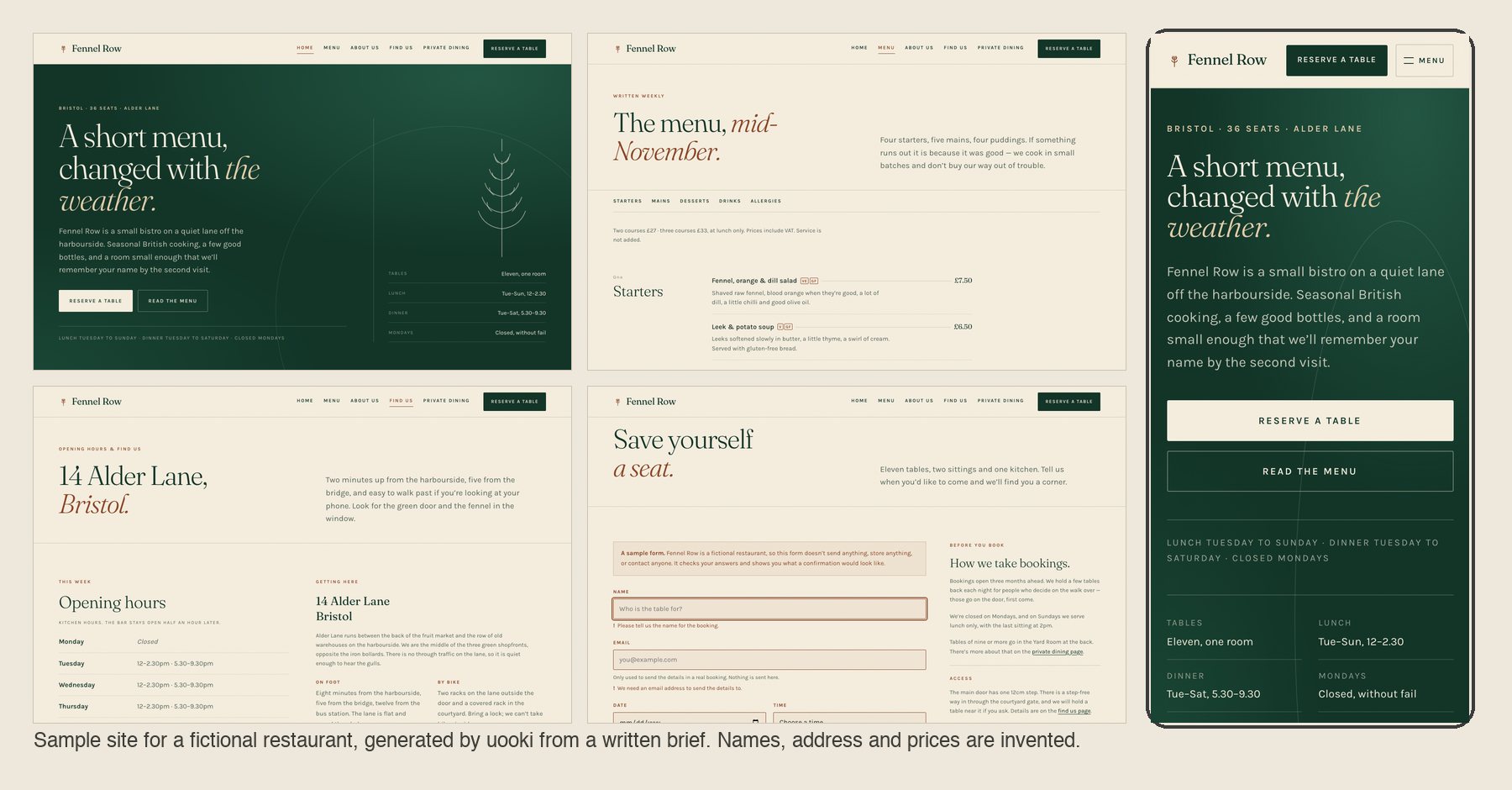
A sample restaurant site built from a written brief
Below are the home, menu, opening hours and booking pages, and the phone layout, of a site built from a written brief for a fictional restaurant. The restaurant, its address, its dishes and its prices are all invented, and every page says so. The booking page is shown after an empty submit, to show the inline errors. The images are screenshots of the result.
What you get from the brief, and what is still yours
A site builder is only honest if it says where its job ends:
| Part of the site | From a written brief | Still yours to do |
|---|---|---|
| Design and copy | A consistent look and first-draft wording on every page, in the tone you ask for | Read every line and rewrite what does not sound like your restaurant |
| Menu | A clear layout with prices and dietary marks | Your real dishes and prices, and allergen information you have checked against your kitchen and your legal duties |
| Opening hours and address | A page that is easy to find and read on a phone | Your real hours and address, kept up to date |
| Booking form | Fields, checks and a confirmation; the sample form sends nothing | Connecting requests to an inbox or a booking tool you use, and deciding how bookings are confirmed |
| Photos | Nothing unless you supply them; the sample used none, because the brief said so | Your own photography |
| Domain and hosting | A site you can open and click through here | uooki has no custom domain support and no CMS, so a live site on your own domain needs the pages hosted elsewhere |
Based on a real run on 2026-11-14. The sample restaurant and everything about it is fictional.
How to brief it
Four things that make the first draft usable:
- Describe the restaurant in a sentence or two. Size, place and the kind of cooking. The sample brief gave the number of seats, the city and "seasonal British cooking", and the voice followed from that.
- List the pages and what is on each. Home, menu, hours and address, booking, and anything else you need. Say which dietary marks you want on the menu and what the booking form should ask.
- Say what to leave out. The sample brief asked for no stock photos, no testimonials and no awards or ratings, and the site has none. Anything you do not want, say so.
- Set the tone, then ask for changes by talking. A line such as "warm, unfussy, serif headings, deep green and cream" sets the look. Then ask for changes in plain sentences: a shorter menu, Sunday lunch only, a different colour.
What this is not
It is not a booking system. There is no table plan, no confirmations and no reminders; the booking page in the sample collects nothing. It is not a content management system either, so there is no editor for a colleague to change a price next month; you change the site by asking the agent. It does not host a site on your own domain, and it does not take payments or deposits.
It also does not know what you are required to say. Rules about allergen information, pricing and food hygiene differ by place, and what a menu or a website must show is for the restaurant to get right. Treat the generated text, including every dietary mark and allergy note, as a draft to be checked.
Finally, the sample was not a single message. The first brief produced the home page, and two follow-up messages finished the other five pages and fixed the links between them. Expect to read the result and ask for changes.
Run it yourself in uookiBuild a website for a six-table neighbourhood cafe in Manchester: a home page, a menu with prices and vegan marks, opening hours and address, and a booking page with a form that checks your answers. Warm and unfussy, no stock photos, no testimonials.
Frequently asked
Can uooki build a restaurant website?
Yes, as a multi-page site you can open and click through. In a real run, a written brief and two follow-up messages produced six pages for a fictional 36-seat bistro. It is a strong first draft, and what is specific to your restaurant, your menu and your legal duties is still yours to supply.
Does the booking form take real bookings?
No. The sample form checks every field and shows a confirmation, and says plainly that nothing has been sent or stored and no table is held. If you need booking requests delivered or confirmed, that has to be connected separately.
Can I use my own domain?
uooki has no custom domain support. You can open and share what it builds here, and if you want the site on your own domain the pages need to be hosted somewhere else.
Will it handle allergen information for me?
No. The sample's dietary marks and allergy notes are invented. What your menu must say about allergens is for you to decide, and every dish needs checking by someone who knows what goes into it.
Are the menu and prices on the sample real?
No. They are invented dishes and prices for a fictional restaurant, there to show the structure. Put your own in, or ask the agent to rework the page around your menu.
Does it work on a phone?
The sample was checked at phone width and the home page does not scroll sideways; the navigation folds into a menu button. Check your own site on your own phone before you rely on it.
How long does it take and what does it cost?
The sample took a few minutes per message, over three messages. The credit line under each reply shows what a run used, and you can try it on the free tier, which is $0 with up to 100 credits (one-time). Paid plans start at $10.75/mo billed yearly ($12.90 monthly).
Does it work for other kinds of business?
The approach is general, since you describe the pages and the tone, but this page reports only the one restaurant sample we built, so we make no claim beyond that.
Sources
- uooki pricing — checked 2026-11-14