The short answer
- What do you get? A Word document with 17 sections and 49 tables: startup costs, a rate sheet, revenue per trip, a month-by-month first year, break-even, licensing steps, risks and a first-year plan. Our run took 8 minutes 35 seconds.
- Are the numbers real? No. They are the plan's own assumptions. Web search was not available on the test setup we used, so the Medicaid rates, wages, van prices and insurance are its estimates, not market data. The plan says so on its first page.
- Does the arithmetic hold? Mostly. The startup costs, the average trip value, the break-even and the twelve-month profit and loss agree. We also found five slips, listed below.
- Can I read the whole plan? Yes. The full text is one click away from this page, unedited, and the original Word file is there too.
What an NEMT business plan needs to answer
People who search for an NEMT business plan are usually about to buy or finance wheelchair vans, apply to Medicaid and its transportation brokers, or ask a bank for a loan. Each of them reads the plan for the same thing: whether the trips pay for the vans. That means the cost to start, the rate for each kind of trip, the average revenue per trip, the cost that stays fixed when the vans are parked, and the number of trips a day that covers it all.
In uooki there is no template to fill in. You write one or two sentences about your company: how many vans, where you operate, who pays for the rides. It writes the whole plan and works out the figures from those facts. Where you gave no number, it picks one and labels it as an assumption.
The honest limit is that a plan built from a sentence knows only that sentence, plus whatever it can look up. In our run it could look up nothing: web search was off, so every rate, fee and wage in it is an estimate, not a figure read from a source. Below we show the plan, what is in it, and where it went wrong.
The first page of the plan we got
This is the first page as uooki showed it. The three vans, Columbus and the kinds of rides came from our sentence. Everything else, from the Medicaid rate to the van price, is an assumption the plan made up and labelled, not market data. Open the full version to read every section.
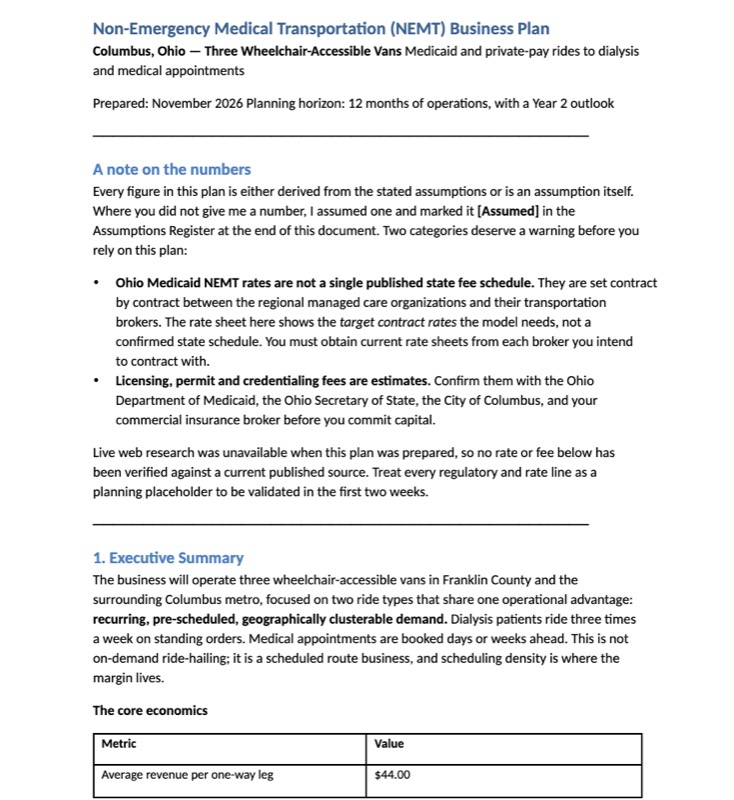
The headline numbers in the sample
These are the figures the plan works from. All of them come from the plan itself:
| Item | In the sample plan |
|---|---|
| Company | Three used wheelchair vans, four drivers, the owner and a part-time scheduler |
| Revenue per trip | $44.00 per one-way trip, $88.00 per round trip |
| Cost per trip | $7.50 of fuel, maintenance, billing and supplies, leaving $36.50 |
| Break-even | 790 one-way trips a month, $34,760 of revenue, about 10 trips per van per day |
| Cost to start | $70,829, inside $120,000 of funding: $50,000 from the owner and a $70,000 loan |
| Vans | Financed separately: $124,800 of vehicle loans |
| Year 1 | $323,180 of revenue and a loss of $16,970; first profitable month is month 7 |
From the plan uooki wrote on 2026-11-26. These are its own estimates, not market data.
Startup costs in the sample
The plan lists every line of the cost to start. These are its category totals:
| Category | Amount | What it covers |
|---|---|---|
| Vans and equipment | $40,590 | Down payments on three vans, wheelchair securement kits, graphics, registration, tablets and card readers |
| Licensing, legal and compliance | $5,300 | Company formation, lawyer, permits, Medicaid and broker enrolment, driver checks, drug testing |
| Insurance and deposits | $8,500 | Two months of insurance deposits and an office deposit |
| Operating setup | $10,000 | Dispatch software, phones, driver training, uniforms, website and clinic outreach |
| Contingency | $6,439 | 10 per cent on top |
| Total | $70,829 |
We added up every line in the plan's own table and got the same total. The van prices and fees are assumptions.
Part of the rate sheet it wrote
The plan sets one price per payer. It says the Medicaid column is a target to negotiate with brokers, not a published rate:
| Charge | Medicaid broker | Facility contract | Private pay |
|---|---|---|---|
| Base fee, first 10 miles | $36.00 | $41.00 | $45.00 |
| Each mile from 11 to 25 | $2.20 | $2.20 | $3.30 |
| Waiting, per 15 minutes after the first 15 | $6.00 | $6.00 | $9.00 |
| No-show | $15.00 | $20.00 | $25.00 |
| Round trip, standing order | $124.00 | ||
| Dialysis, three times a week, per month | $1,450.00 |
The full rate sheet in the plan has fifteen lines. Every rate is an estimate the plan made, not a broker's schedule.
How it got to an average of $44 a trip
The plan weighs each payer by its share of trips:
| Payer | Share of trips | Revenue per trip |
|---|---|---|
| Medicaid broker | 68% | $38.50 |
| Facility contract | 12% | $41.00 |
| Private pay | 20% | $64.20 |
| Weighted average | 100% | $43.94 |
We checked the weighting and it is right. The plan rounds it to $44.00.
How thin the margin is
The plan is blunt that the company only works when the vans are nearly full. Its own table, with costs held at $28,805 a month:
| Share of capacity used | Trips a month | Monthly profit or loss |
|---|---|---|
| 100% | 936 | $5,359 |
| 85% | 796 | $249 |
| 80% | 749 | −$1,467 |
| 75% | 702 | −$3,182 |
We recomputed these rows from its trip value and costs and got the same results.
What we checked, and the slips we found
We redid the arithmetic in the plan from its own tables. This is what held and what did not:
The core model adds up
The startup costs add up to $70,829. The weighted trip value, the cost per trip of $7.50 and the break-even of 790 trips a month all follow from the plan's inputs. Each month of the first-year profit and loss is within a few dollars of our own calculation, and the van payment of $853 a month is right for the loan it assumed.
It checked itself twice
It wrote the document three times in one run, each time saying it had found figures that did not agree. The page and the full version show the last version.
Slip 1: a correction that was wrong
It decided that a payment of $945 a month on a $70,000 ten-year loan did not fit a 10.5 per cent rate, and changed the rate to 10.7 per cent. In fact $945 is exactly the 10.5 per cent payment; at 10.7 per cent it would be a little higher.
Slip 2: the second-quarter comparison
It says raising private-pay rides from 15 to 30 per cent is worth about $2,370 a month, more than the whole second-quarter loss. Its own table puts that loss at $8,056.
Slip 3: the same point in the summary
The closing section says $2,050 a month is more than a third of the second-quarter loss. It is about a quarter.
Slip 4: debt cover
It gives an average debt-service coverage of 0.68 for the first year. With its own first-year figures it comes to about 0.60.
Slip 5: when the vans arrive
The profit and loss charges loan payments and insurance for all three vans from month 1, at $9,005 a month. Its own launch plan says to buy one van first and wait for a signed broker contract before buying the other two. Pick one, and redo the early months.
How to get a plan you can take to a lender
Five things make the first draft closer to something you can use:
- Give the facts you already have. The number of vans, the area, who pays for the rides, and any broker rate sheet, insurance quote or loan offer you have. We gave none of those, so all of them were estimated.
- Ask for the sections a lender reads. Startup costs, a rate sheet, revenue per trip, monthly revenue, fixed costs, break-even and a first-year plan. We asked for those by name and got all of them, plus licensing steps and a risk table.
- Ask it to list its assumptions. Our request said: where I haven't given a number, assume one and say so. The plan ended with a register of every assumption and marked the ones to verify first.
- Check the arithmetic yourself. Add up the big tables and test the break-even. It took us a short while and turned up the five slips above.
- Replace the estimates, then ask again. Get real broker rates, insurance quotes and van prices, then send them in the chat. The plan is rewritten around your numbers.
What this is not
It is not financial, legal or tax advice. The plan lists licences, permits and enrolment steps for Ohio, and says itself that each one must be confirmed with the agency. We did not check any of them.
It is not market research. On the setup we used, web search was off, so the Medicaid rates, broker terms, wages, van prices and insurance costs are the plan's own estimates, not market data. When search is available it may look things up, but check any number before you rely on it.
And it is not a promise that a broker will contract with you or that a bank will lend. We ran one request, read the result and checked its arithmetic. That is all this page claims.
Run it yourself in uookiWrite a complete business plan for the non-emergency medical transportation (NEMT) company I'm starting: three wheelchair-accessible vans in Columbus, Ohio, taking Medicaid and private-pay rides to dialysis and doctor appointments. Include startup costs, a rate sheet, the average revenue per trip, monthly revenue assumptions, a break-even point and a first-year plan. Where I haven't given a number, assume one and say so. Text and tables only, no images.
Frequently asked
Is this an NEMT business plan template?
No. There is no template to fill in. You describe your company and uooki writes the whole plan, including the numbers. The sample on this page is one real result, not a form.
How much does it cost to start an NEMT company?
In the sample, three wheelchair vans in Columbus needed $70,829 to start, with the vans themselves financed on top. Those figures rest on the plan's own estimates of van prices, insurance and fees, so treat them as a worked example, not a quote.
Where do the Medicaid rates come from?
In our run, from the plan's own estimates. Web search was not available, and the plan said the Medicaid column is a target to negotiate with brokers, not a published schedule. Get the real rate sheet from each broker.
Does it cover licensing and Medicaid enrolment?
It lists the steps it expects for Ohio, with estimated fees and lead times, and marks them to verify. We did not check them, and they differ by state.
What format is the plan in?
Ours was a Word document. The full text on this page is that document converted for the web without edits, and the original Word file is linked from it.
How long does it take?
Our run took 8 minutes 35 seconds from sending the sentence to the finished document. It was on a local test setup, so yours may be faster or slower.
Can I change the plan after it is written?
You can reply in the chat with a real broker rate or van price and ask for the plan to be updated. We did not test a second round in this run.
Sources
- uooki sample plan, full text — checked 2026-11-26