The short answer
- Need a one-off competitive analysis you can hand to a team? That is the job. One request produces a report with an executive summary, a comparison table, detail per competitor, a SWOT for each, a recommendation and numbered citations.
- Need continuous tracking, with alerts when a competitor changes a page or a price? uooki does not do that. It researches when you ask and gives you the result; it does not watch pages on a schedule. A monitoring product is the right shape for that job.
- Need data that sits behind a login or a paywall? Out of reach. The agent reads what is on the public web, so figures that only exist in a paid report or a customer dashboard will show up as gaps, not guesses.
- Want to see whether it is any good before paying? Run it on the free tier: $0 with up to 100 credits (one-time). The credit line under each reply shows what a run cost.
What a competitive analysis needs
A competitive analysis is a decision document, not a list of facts. It answers a question such as "which of these three tools should a fifteen-person product team standardise on" or "where is our pricing out of line", and everything in it is there because it bears on that question. The facts are the easy part. The work is choosing the same dimensions for every competitor, finding evidence for each, noticing when two sources disagree, and saying clearly what you could not find out.
That is why a one-line chat answer does not make a good competitive analysis, and why a spreadsheet of scraped prices does not either. The first has no evidence and the second has no judgment. What people actually hand to a team is a short report with a table in the middle and a recommendation at the end, with the sources numbered so a sceptical reader can check any line.
How uooki produces the report
Four stages, which you can watch as the session runs:
- Plan. The agent writes down the sub-questions the answer needs, one line each, and one sentence on the angle. If you listed what to check, it uses your list instead.
- Gather. Sub-questions that can be researched independently, usually one per competitor, run as separate tasks in parallel. Each reads pages from the public web and returns findings with the sources it used, and a list of what it could not resolve.
- Check. Findings are compared across competitors and sources: same units, same period, same definition. Where sources disagree the report says so, and a figure that rests on a single source is marked as such. Gaps get a follow-up search or stay in the report as gaps.
- Write. One report: an executive summary, a comparison table, detail for each competitor, and a conclusion or recommendation, with numbered citations. You can then ask for it as a document, a spreadsheet or a short deck.
What is in the report
Five parts, in the order a reader meets them:
Executive summary
The answer first: what the comparison shows and what it suggests for your decision, in a short paragraph a busy reader can stop at.
Comparison table
The competitors side by side on the same points: pricing as published, target customer, main features, limits. Every cell traces back to a numbered source.
SWOT for each competitor
Strengths, weaknesses, opportunities and threats per product, from the evidence gathered. A SWOT is a judgment, not a measurement, so each line points to the finding it rests on rather than standing alone.
Positioning and gaps
Where the competitors cluster, where nobody is, and what that implies for you. Where the evidence is thin the report says so instead of filling the space.
Recommendation and sources
A clear read on what to do, followed by the numbered source list. Figures that rest on one source are marked, and disagreements between sources are called out.
Which job needs which kind of tool
Three different jobs get called "competitive analysis". They want different tools:
| The job | What fits it | Where uooki stands |
|---|---|---|
| A one-off analysis for a decision | A research agent that writes a sourced report | This is the case it is built for |
| Ongoing tracking, with alerts on changes | A monitoring service that watches pages on a schedule | Not what uooki does; you would re-run the analysis when you need a fresh one |
| A quick answer to one narrow question | A search or chat assistant | It can answer, but a full report is more than that question needs |
This table describes kinds of tools, not specific vendors. No competitor product or price is claimed on this page.
How to brief it so the report is useful
Four things that make the difference between a generic report and one you can use:
- Name the competitors. Give the two to five products you want compared. Leave the list open and the agent has to guess which ones count.
- Say what the decision is. A report written for "which should a 15-person product team standardise on" reads differently from one for "where should we price against them". The decision decides which dimensions matter.
- Add what you already know. Your own pricing, your own positioning, the customers you are trying to win. The agent compares them against the evidence instead of inventing your side.
- Ask for the gaps. Tell it to list what it could not verify. A report that admits its gaps is easier to trust than one that has none.
Limits, stated plainly
The agent reads the public web. Anything that sits behind a login, inside a paid market report or in a customer-only dashboard is out of reach, and the report will show it as a gap. Pricing is read as published, which is not always what a buyer ends up paying, and the report is a snapshot with a date, not a feed.
There is no scheduled monitoring and no alerting. If you need to know the day a competitor changes a plan, that is a different kind of product. What uooki gives you is the analysis on demand: ask again when you need a fresh one, and the sources are numbered so you can see what changed.
A report is also not a substitute for reading the sources that matter most. Check the citations behind any figure you are about to put in front of a customer or an investor, which is the reason they are numbered.
An excerpt from a real run
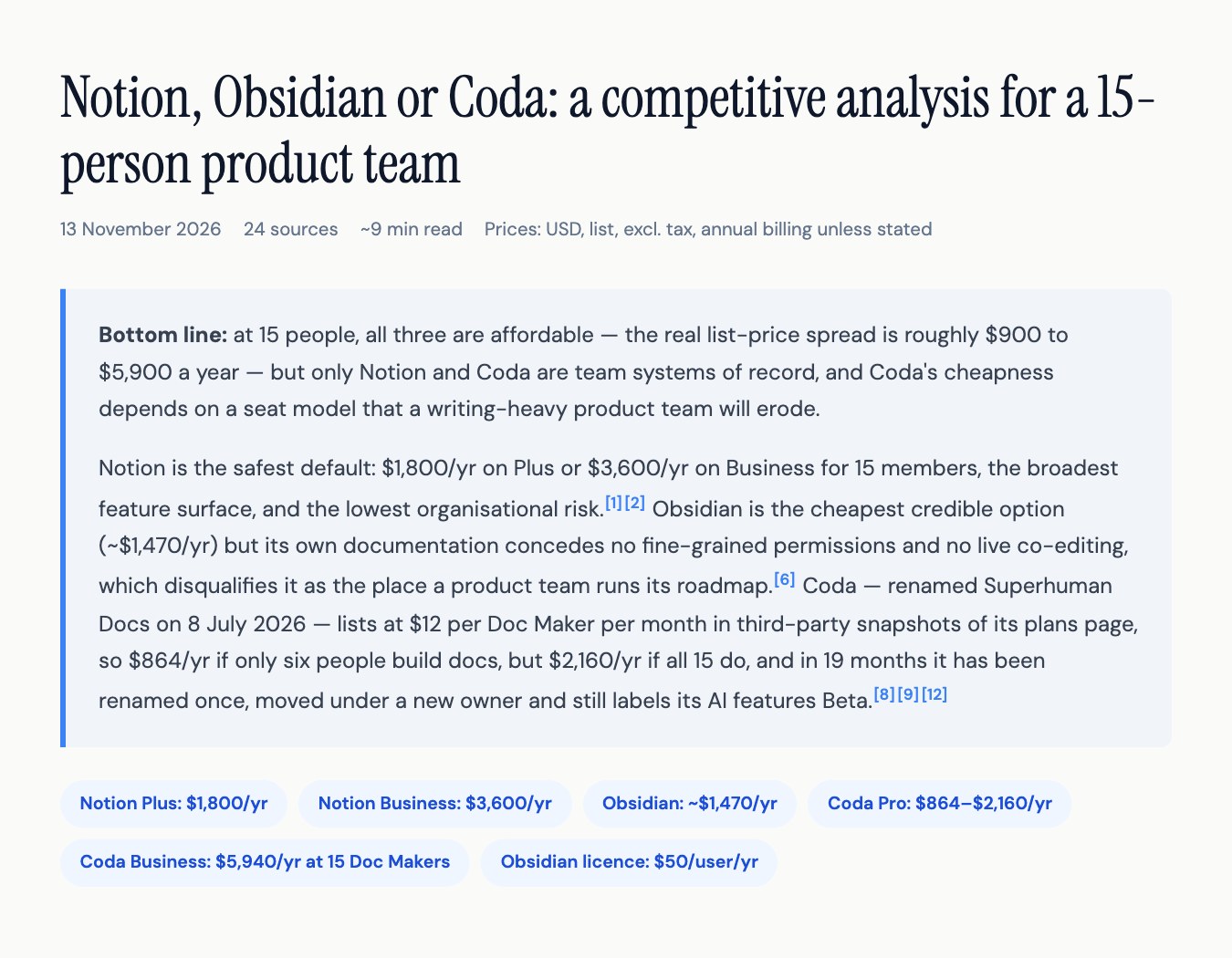
This is the top of a report the research agent wrote from the brief shown on this page: Notion, Obsidian and Coda for a 15-person product team. After the first draft we asked it to double-check some of its own claims before sharing, and it corrected the ones the sources did not support and marked others as unverified. Open the full report to see every source.
Run it yourself in uookiWrite a competitive analysis of Notion, Obsidian and Coda for a 15-person product team: pricing as published, strengths and weaknesses, a SWOT for each, and a recommendation, with numbered sources
Frequently asked
What is a competitive analysis tool?
Software that gathers evidence about competitors and organises it so you can make a decision: who they are, what they sell, how they price, where they are strong and weak. The useful ones return the evidence with the comparison, not just the comparison.
Can uooki generate a SWOT analysis?
Yes, as part of a competitive analysis report: a SWOT for each competitor, built from the findings gathered and linked to the sources behind them. A SWOT is a judgment rather than a measurement, so treat it as a structured reading of the evidence and check the citations behind anything you rely on.
Does it monitor competitors continuously?
No. It researches when you ask and returns a dated report. It does not watch pages on a schedule or send alerts, so if you need change notifications, a monitoring product is the right shape. You can re-run the analysis whenever you need a fresh snapshot.
Where does the data come from?
The public web: competitor sites, pricing pages, documentation, public reviews and news. Each finding carries the sources it came from, and the report numbers them. Data behind a login or a paywall is not available and shows up as a gap.
How accurate is it?
As accurate as the sources, and the report is built to show that: it compares figures across sources, marks any figure that rests on a single source, and calls out disagreements. It can still misread a page, which is why the citations are numbered. Check the ones that matter before you act on them.
How long does a report take, and what does it cost?
It is a multi-step research run, so it takes longer than a chat answer. The credit line under each reply shows what it cost, and you can try it on the free tier, which is $0 with up to 100 credits (one-time). Paid plans start at $10.75/mo billed yearly ($12.90 monthly).
Can I get the report as a document or a deck?
Ask for it in the format you need: the report is a page in the session, and the same agent can produce a Word document, a spreadsheet of the comparison table or a short deck from it.
Can I compare my own company with competitors?
Yes. Give the agent your own pricing, positioning and target customer in the brief, and it compares them against what it finds. It will not invent facts about your side, so anything you leave out shows up as a gap.
Sources
- uooki pricing — checked 2026-11-13