The short answer
- Want to see what your company site could look like? Describe what you make, who you sell to and what each page should say. You get a working site you can click through, with its product filters and quote form working in the browser.
- Need the quote form to reach you? It does not. The form on the sample checks the fields and shows a confirmation, but it sends nothing and saves nothing. Something has to be connected behind a real form, and uooki does not set that up.
- Can you use the certifications and numbers it writes? No. Every certificate, tolerance, machine and address in the sample is invented. Replace them with your real ones, and never publish a claim you cannot prove.
- Want a domain and hosting handled? This page does not promise either. uooki does not register a domain for you, and we make no promise about how long a published page stays online.
What a manufacturing website has to do
The buyer is usually an engineer or a purchaser with a part to source. They are not browsing; they are checking whether you could be on a shortlist. So the site has a short job list: say what you make and to what standard, show the work, list the equipment, state your certifications honestly, and make asking for a quote easy.
That is why most strong manufacturing sites share a layout. A home page that says in one sentence what you make and for whom. A products or capabilities page that lets a buyer find their kind of part. A quality page with certifications and how you inspect. A facility page with the machine list. A contact page where the request for a quote can be sent. The sample here follows that layout, which is a sound starting point, not the only one.
What the sample site contains
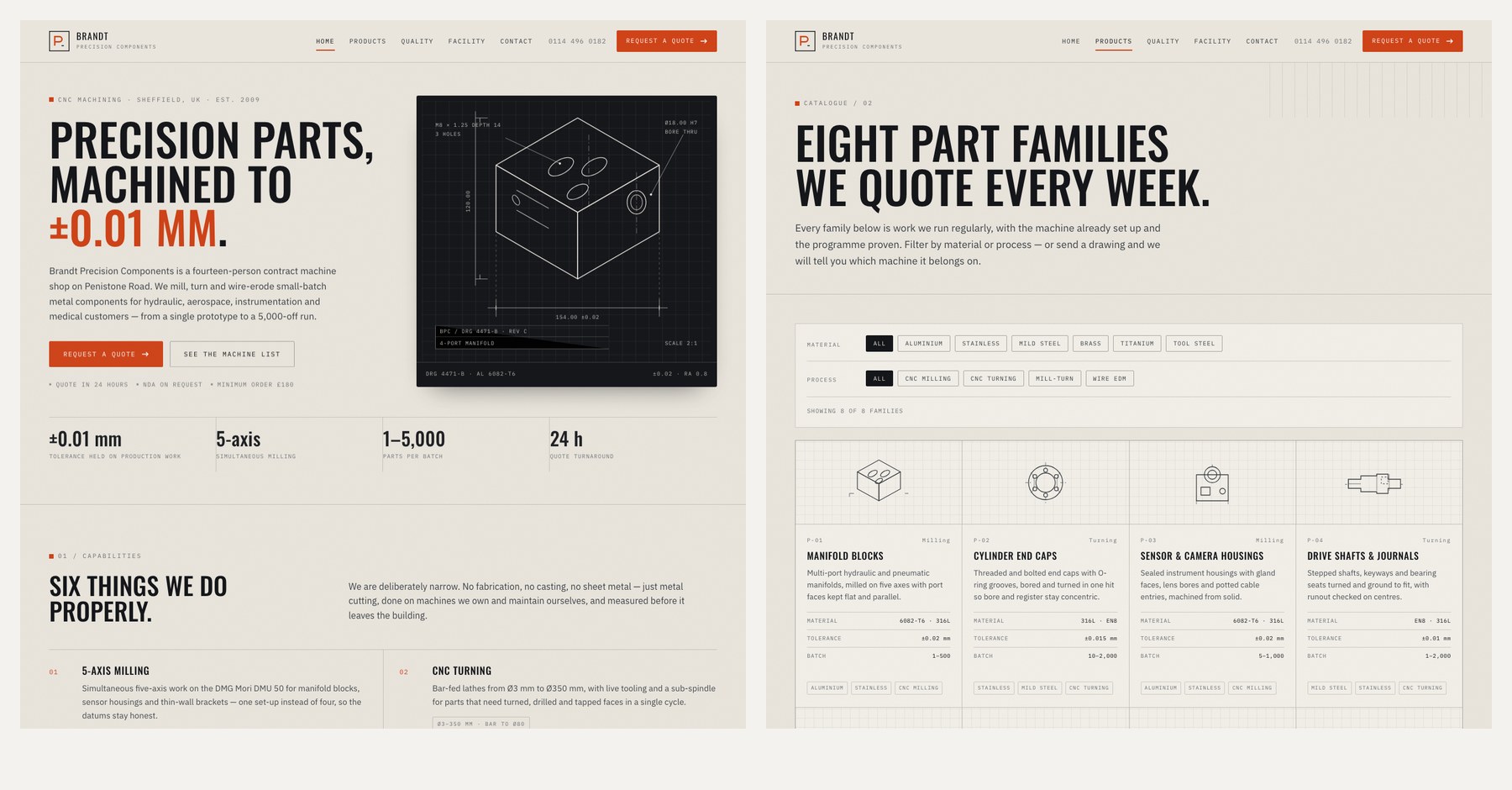
We asked for a site for an invented machine shop called Brandt Precision Components. What came back is a single page file with five views you move between with the menu:
Home
A headline, a short introduction, the main capabilities, a line drawing of a machined part and a clear Request a quote button.
Products and capabilities
A catalogue of eight part families, each with materials, a tolerance and a batch size. Buttons filter it by material and by process, with a count such as "Showing 2 of 8 families" and a Clear filters button.
Quality and certifications
Certification blocks, the working procedures, a table of inspection equipment and the paperwork that ships with parts. All of it is invented text.
Facility and equipment
A floor-plan drawing, a few facility figures, a table of machines grouped by process and working hours.
Contact and request a quote
Contact details and a form for name, company, email, phone, part description, quantity and a drawing file. It checks each field and then shows a confirmation with a reference number.
A sample manufacturing company website built from one description
Below are the home view and the products view of the sample, as it looks in a browser. The company, its figures and its drawings are all invented. The sample was built with no photographs, because we asked for none. The images are screenshots of the result.
What it made up
A generated site fills the gaps with plausible detail. In the sample, we gave it a name, a town, a list of pages and a style. It then wrote all of this itself:
| What we asked for | What the site said | Why it matters |
|---|---|---|
| "A small contract manufacturer of CNC-machined metal parts" | A company size, a founding year, a street address, a phone number and an email address | None of it was in the request. A real company has to replace all of it |
| "A quality and certifications page (ISO 9001 style)" | Certification blocks with certificate numbers, audit dates, a list of inspection equipment and calibration intervals | These read as facts. The site carries a footer line saying nothing is real. Do not publish certifications you do not hold |
| "A facility and equipment page (machine list)" | Named machine models, a number of machines and a floor plan | Invented. List the equipment you actually run |
| "A catalogue of 8 part families" | Eight families with materials, tolerances and batch sizes | The tolerances and batch sizes are guesses, and a buyer will rely on them |
| "A form that validates and shows a confirmation" | A confirmation that says a copy is sent to the buyer and that estimating will reply within one working day | The form sends nothing. That wording is the sample's own, and it would be false on a live site |
Based on a real run on 2026-11-16. The company in the sample is fictional.
What you get, and what is still yours
A generated site is a draft. The split looks like this:
| Part of the site | What you get | Still yours to do |
|---|---|---|
| Layout and pages | Five views with a menu, a layout that works at phone width, and a style that matches your description | Read every page. The sample had two labels overlapping on the floor plan, and a grey gap in the product grid when a filter left fewer than a full row of cards |
| Product catalogue | Part families with a filter by material and by process, working in the browser | Replace the parts and the figures with your own. The catalogue is text on the page, not a database you edit |
| Quote form | A form that checks each field and shows a confirmation | It sends and saves nothing. Connect a real form service or your own system, and rewrite the confirmation to say only what is true |
| Certifications and claims | Placeholder text in the style you asked for | Replace it with certificates you hold, with their real numbers. Do not publish anything you cannot back up |
| Photos | The sample has none, because we asked for none. The pictures on it are generated line drawings | Add your own photographs of your parts and your shop if you want them |
| Domain, hosting and a CMS | None. uooki does not register a domain, make no promise about how long a published page stays online, and it has no content management system | Choose where it lives and how you will edit it afterwards |
| Leads and follow-up | None. No inbox for enquiries, no customer records, no quoting | Decide where enquiries go and how you will answer them |
Based on a real run on 2026-11-16. The sample company is fictional.
How to ask for a manufacturing website
Four things make the first draft close to usable:
- Say what you make and for whom. The processes, the materials and the kinds of customer, in a few lines. Include a town and any real range, such as batch sizes, so it does not guess.
- List the pages you want. Products, quality, equipment and contact are the usual four, plus a home page. Say what a buyer should be able to do on each, such as filter the catalogue.
- Say what to leave out. Ask for no photographs and no testimonials if you have neither, so it does not invent them. Ask it to keep the certifications as placeholders.
- Give it your real details after. Ask for changes in plain sentences, and paste in your real certifications, equipment and contact details. Each change makes a new version of the same site.
What this is not
It is not a way to look more established than you are. The site it builds will read like a real company unless you replace the placeholder claims, and putting invented certifications or tolerances in front of buyers is a risk to you, not a feature.
It does not run the business side. There is no enquiry inbox, no customer list, no quoting and no connection to your systems. The quote form in the sample is a working drawing of a form: it looks right and checks its fields, but nothing leaves the browser.
And it does not host or edit the site for you. There is no domain registration and no content management system, and we make no promise about how long a published page stays online. Treat the result as a draft you can look at, change by asking, and then move to wherever you intend to run it.
Run it yourself in uookiBuild a website for Brandt Precision Components, a small contract manufacturer of CNC-machined metal parts in Sheffield, UK. Pages: a home page (headline, short intro, key capabilities, and a clear 'Request a quote' button); a products and capabilities page with a catalogue of 8 part families that can be filtered by material and process; a quality and certifications page (ISO 9001 style, inspection equipment); a facility and equipment page (machine list); and a contact / request-a-quote page with a form (name, company, email, phone, part description, quantity, drawing file) that validates and shows a confirmation. Clean, industrial look. No stock photos and no customer testimonials. Add a footer line saying this is a sample site for a fictional company.
Frequently asked
Can uooki build a website for a manufacturing company?
It builds a working draft of one from a description: a home page, a filterable product catalogue, a quality page, an equipment page and a contact page with a quote form. You read it, correct it, and put in your real facts. It cannot know what you do not tell it, and it fills in gaps with invented detail.
Does the quote form send me the request?
No. The form checks the fields and shows a confirmation, but it sends nothing and saves nothing, so a file chosen in its drawing field goes nowhere. To receive enquiries you need to connect a real form service or your own system, and uooki does not set that up.
Can I use the certifications, tolerances and machines it wrote?
No. They are placeholders. Replace them with your own certificates and equipment, and do not publish a claim you cannot prove to a buyer.
Does it include photographs?
Not in the sample, because we asked for none. The pictures on it are line drawings the site drew itself. Add your own photos of your parts and shop afterwards if you want them.
Can the catalogue filter by material and process?
In the sample it can. Buttons filter the eight part families by material and by process and show how many match, and a Clear filters button resets them. The filter works on the page itself. It is not connected to a database or an inventory system.
Does it register a domain or host the site?
No. uooki does not register a domain, and we make no promise about how long a published page stays online. There is no content management system either, so you change the site by asking for changes.
Does it work on a phone?
The sample has a menu button and no sideways scrolling at phone width. As with any generated site, look at every page yourself on the devices your buyers use.
How much does it cost?
A whole site is a long run. The sample took under six minutes and the credit line under it showed 82 credits. What a run uses depends on how much you ask for, so check the credit line on yours. You can try it on the free tier, which is $0 with up to 100 credits (one-time). Paid plans start at $10.75/mo billed yearly ($12.90 monthly).
Sources
- uooki pricing — checked 2026-11-16