The short answer
- What do you get? A Word document with 21 sections and about 20 tables: startup costs, a price list, the average ticket, a month-by-month first year, a three-year profit and loss, break-even and a first-year plan. Our run took 8 minutes 58 seconds.
- Are the numbers real? They are assumptions, and the plan says so on its first page. Web search was not available on the test setup we used, so rent, wages and competitor prices are its own estimates. Replace them with local quotes.
- Does the arithmetic hold? Mostly. We added up the startup costs, the twelve months of revenue and the three-year profit and loss, and they agree. We also found four slips, listed below.
- Can I read the whole plan? Yes. The full text is one click away from this page, unedited, and the original Word file is there too.
What a hair salon business plan needs to answer
Most people who search for a hair salon business plan are about to sign a lease, ask a bank for a loan or bring in a partner. Each of them reads the plan for the same thing: whether the numbers make sense. A plan that only describes the salon, the brand and the mission will not get far. It needs the cost to open, the menu with prices, the number of client visits you expect each month, the costs that stay fixed when the chairs are empty, and the point where revenue covers all of it.
A template gives you the headings and leaves the numbers blank. In uooki there is no template to fill in. You write one or two sentences about your salon: how many chairs, where it is, what services you offer, anything you already know about rent or prices. It writes the whole plan and works out the figures it needs from those facts. Where you gave no number, it picks one and labels it as an assumption.
The honest limit is that a plan built from a sentence knows only that sentence, plus whatever it can look up. Below we show one real plan, what is in it, and where it went wrong.
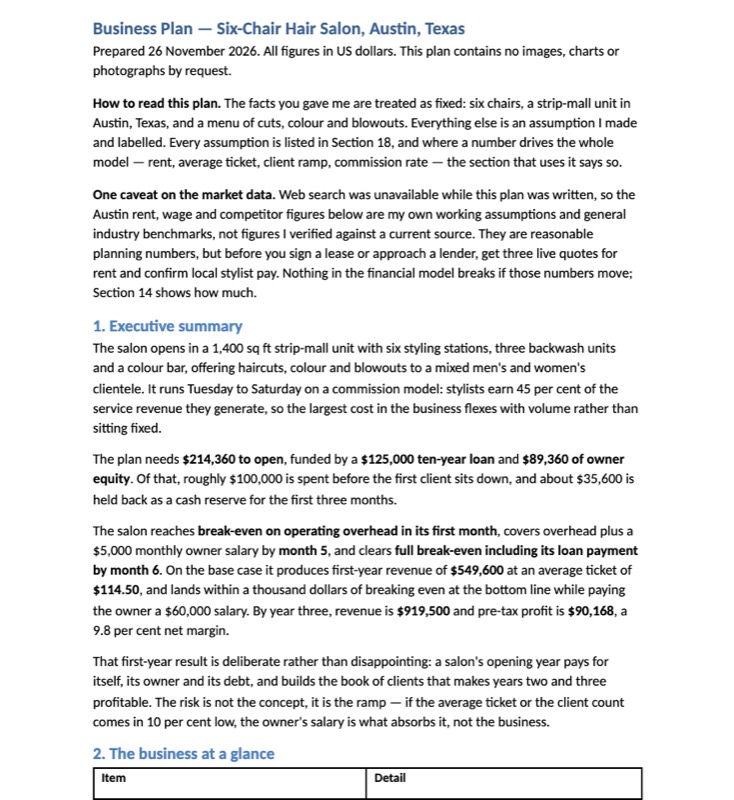
The first page of the plan we got
This is the first page as uooki showed it. The six chairs, Austin and the services came from our sentence. Everything else, from the rent to the loan, is an assumption the plan made up and labelled, not market data. Open the full version to read all 21 sections.
The headline numbers in the sample
These are the figures the plan works from. All of them come from the plan itself and rest on its own assumptions:
| Item | In the sample plan |
|---|---|
| Salon | Six chairs, three backwash units and a colour bar in a 1,400 sq ft strip-mall unit |
| Cost to open | $214,360, funded by a $125,000 loan and $89,360 from the owner |
| Average ticket | $114.50 per visit: $106.05 for the service plus $8.45 of retail |
| Break-even | $44,830 of revenue a month, about 392 client visits |
| Year 1 | $549,600 of revenue from 4,800 visits, about break-even after a $60,000 owner salary |
| Year 3 | $919,500 of revenue and $90,168 of profit before tax |
From the plan uooki wrote on 2026-11-26. Assumptions, not quotes.
Startup costs in the sample
The plan lists every line of the cost to open. These are its category totals:
| Category | Amount | What it covers |
|---|---|---|
| Pre-opening | $36,360 | Deposit, first month of rent, licences and permits, hiring, two weeks of training pay, brand and booking page, opening marketing |
| Design and build-out | $63,100 | Drawings and permits, fit-out of 1,400 sq ft, signage, less the landlord's allowance |
| Equipment and fixtures | $48,500 | Six stations, three backwash units, colour bar, reception, washer and dryer, tools, till and booking system |
| Opening stock | $11,300 | Retail products and colour stock |
| Cash reserve | $35,600 | Three months of fixed costs kept in the bank |
| Contingency | $19,500 | About 10 per cent on top |
| Total | $214,360 |
We added up every line in the plan's own table and got the same total.
The price list it wrote
The plan built its average ticket from a menu and the share of visits each service gets. Part of that menu:
| Service | Price | Share of visits |
|---|---|---|
| Women's haircut and style | $75 | 30% |
| Men's haircut | $55 | 16% |
| Blowout, wash and style | $65 | 14% |
| Root touch-up | $105 | 10% |
| Partial foil or highlight | $215 | 8% |
| Balayage | $300 | 4% |
| Average across the full menu | $106.05 | 100% |
The full menu in the plan has twelve services. We checked the weighted average and it is right.
Break-even, three ways
Instead of one break-even number, the plan gives three: when the salon covers its running costs, when it can also pay the owner, and when it can also pay the loan:
| Covers | Revenue needed each month | Client visits | Plan says it gets there in |
|---|---|---|---|
| Rent and running costs | $28,690 | 251 | Month 1 |
| Plus a $5,000 owner salary | $40,760 | 356 | Month 5 |
| Plus the loan payment | $44,830 | 392 | Month 6 |
Month 1 in the plan has 250 visits, one short of the first line. See the slips below.
What we checked, and the slips we found
We redid the arithmetic in the plan from its own tables. This is what held and what did not:
The big tables add up
Every line of the startup costs adds up to $214,360. The twelve months of revenue add up to the year-one total, give or take rounding. Each line of the three-year profit and loss follows from the lines above it, and the loan payment of $1,687 a month is right for the rate and term it chose.
It checked itself once
After writing the document, it said it had found four figures that did not agree and saved a corrected version in the same run. The page and the full version show that corrected version.
Slip 1: break-even in month 1
The summary says the salon covers its running costs from the first month. Its own numbers say month 1 brings 250 visits against 251 needed, and its milestone table puts that point in month 2.
Slip 2: the rent example
It says rent 20 per cent above the assumption would need 250 extra client visits a month. With its own figures, that is about 21 a month.
Slip 3: the colour share
It says colour services are 34 per cent of visits. Its own price list adds up to 32 per cent.
Slip 4: the opening marketing
One section counts the opening marketing inside the first-year marketing budget, and another says it comes on top. Decide which, and fix the other.
How to get a plan you can take to a lender
Five things make the first draft closer to something you can use:
- Give the facts you already have. The number of chairs, the town, the services, and any rent quote, loan offer or prices you have. In our run we gave none of those, so all of them were guessed.
- Ask for the sections a lender reads. Startup costs, a price list, the average ticket, monthly revenue, fixed costs, break-even and a first-year plan. We asked for those by name and got all of them.
- Ask it to list its assumptions. Our request said: where I haven't given a number, assume one and say so. The plan ended with a table of every assumption and how much each one moves the result.
- Check the arithmetic yourself. Add up the big tables and test the break-even. It took us a few minutes and turned up the four slips above.
- Replace the guesses, then ask again. Get real rent quotes, stylist pay and a loan offer, then send them in the chat. The plan is rewritten around your numbers.
What this is not
It is not financial, legal or tax advice. The plan itself says that the entity, tax, lease and employment contracts need a professional, and we agree.
It is not market research. On the setup we used, web search was off, so the Austin rent, the stylist pay, the loan rate and the competitor prices are estimates, not figures read from a source. The plan said this in its first lines. When search is available it may look things up, but check any number before you rely on it.
And it is not a promise that a bank will lend. We did not show the plan to a lender. We ran one request, read the result and checked its arithmetic. That is all this page claims.
Run it yourself in uookiWrite a complete business plan for the hair salon I'm opening: six chairs in a strip-mall unit in Austin, Texas, doing cuts, colour and blowouts. Include startup costs, a price list, the average ticket, monthly revenue assumptions, a break-even point and a first-year plan. Where I haven't given a number, assume one and say so. Text and tables only, no images.
Frequently asked
Is this a hair salon business plan template?
No. There is no template to fill in. You describe your salon and uooki writes the whole plan, including the numbers. The sample on this page is one real result, not a form.
How much does it cost to open a hair salon?
In the sample, a six-chair salon in Austin came to $214,360, including a cash reserve and a contingency. That figure rests on the plan's own assumptions about rent and fit-out, so treat it as a worked example, not a quote for your town.
Where do the numbers come from?
From your request, and where you give none, from the plan's own assumptions. In our run web search was not available, so every market figure was an estimate, and the plan said so. Every assumption was listed in one table.
Can I change the plan after it is written?
Yes. Reply in the chat with a new rent, price or number of chairs and ask for the plan to be updated. We did not test a second round in this run, so we cannot say how many sections it rewrites.
What format is the plan in?
Ours was a Word document. The full text on this page is that document converted for the web without edits, and the original Word file is linked from it.
How long does it take?
Our run took 8 minutes 58 seconds from sending the sentence to the finished document. It was on a local test setup, so yours may be faster or slower.
Can it write a plan for a barbershop, nail salon or spa?
You can ask for any business in the same way. We have only run and checked the hair salon plan on this page, so we show only that one here.
Sources
- uooki sample plan, full text — checked 2026-11-26